
Why Do I Keep Procrastinating Things That Matter? The Hidden Emotional Reasons Behind Procrastination
Do you keep delaying important things even when you deeply care about them? This article explores the hidden emotional reasons behind procrastination, including fear, shame, perfectionism, anxiety, overwhelm, self doubt, and nervous system freeze.
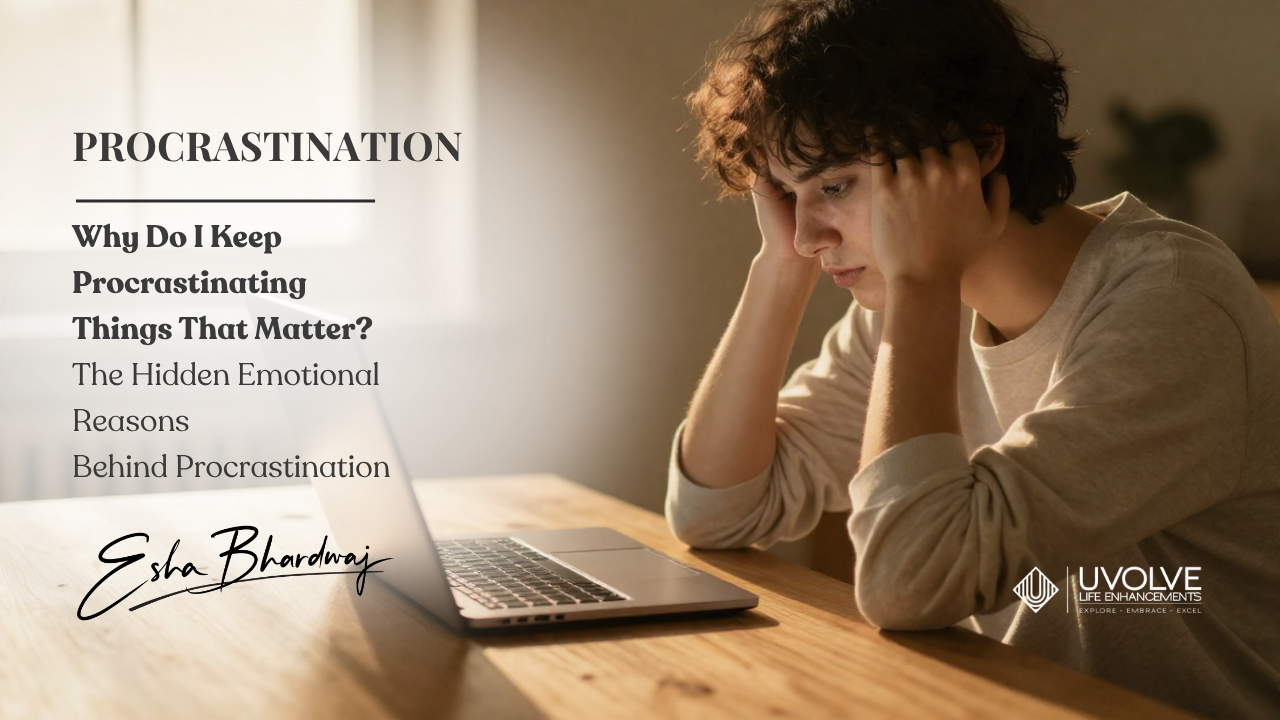
There is a particular kind of frustration that only someone who procrastinates truly understands.
It is not that you do not care.
In fact, most of the time, you care too much.
You know the task matters. You know the deadline is real. You know the conversation needs to happen. You know the form needs to be filled, the call needs to be made, the decision needs to be taken, the work needs to be started.
And still, something inside you freezes.
You sit there looking at the task, thinking about it again and again, sometimes for hours, sometimes for days, sometimes for months.
You may even do everything else except the one thing that actually matters.
You clean your room. You reply to less important messages. You scroll. You research. You make tea. You organise your desk. You plan how you will start. You promise yourself you will begin in ten minutes.
Then the ten minutes become evening.
The evening becomes tomorrow.
Tomorrow becomes next week.
And somewhere inside, the guilt starts getting heavier.
You begin asking yourself,
Why am I like this?
Why do I keep delaying things that matter?
Why can I do difficult things for others but not for myself?
Why do I wait until the last minute even when I know it will hurt me?
Why do I avoid the very things that could change my life?
And the most painful question of all.
Am I lazy?
Let us start there.
No, procrastination is not always laziness.
Sometimes procrastination is emotional overwhelm in disguise.
Sometimes it is fear.
Sometimes it is pressure.
Sometimes it is perfectionism.
Sometimes it is your nervous system trying to protect you from something that does not feel safe, even if your logical mind knows the task is important.
This is why advice like “just start” often feels insulting.
Because if it were that simple, you would have already done it.
What Will You Learn In This Article?
In this article, you will understand:
What procrastination really means emotionally
Why you delay important tasks even when you care about them
How fear, shame, pressure, and overwhelm hide behind procrastination
Why your body may freeze when your mind wants to move
How childhood patterns can affect your ability to start or complete things
Why procrastination often gets worse around meaningful goals
How anxiety, ADHD traits, and executive functioning challenges can make procrastination harder
How to begin healing procrastination without attacking yourself
Why Do I Procrastinate Things That Matter Most?
You may notice something strange.
You do not procrastinate everything equally.
You may be able to help someone else solve a problem immediately, but delay your own important work.
You may finish urgent tasks for clients, family, children, or colleagues, but avoid the task that is directly connected to your own growth.
You may complete small daily things, but freeze around the thing that could actually change your life.
Starting your website.
Applying for the opportunity.
Booking the appointment.
Ending the relationship.
Having the honest conversation.
Finishing the course.
Recording the video.
Writing the proposal.
Making the payment.
Checking the report.
Looking at your finances.
Taking your health seriously.
Choosing yourself.
The more something matters, the more emotional weight it carries.
And the more emotional weight it carries, the more your system may resist it.
Not because you are careless.
Because part of you knows,
If I do this, something may change.
And change can feel exciting to one part of you and terrifying to another.
Procrastination Is Often Not A Time Problem
Most people think procrastination is about time management.
Sometimes it is.
But often, it is not.
You may already know how to make a list. You may already own planners, calendars, productivity apps, reminders, notebooks, and sticky notes.
You may have watched videos on discipline, habits, routines, and motivation.
You may have tried waking up early, making schedules, blocking your time, deleting apps, and promising yourself that this time you will do better.
Still, the same pattern returns.
That is because procrastination is not always a planning issue.
Sometimes it is an emotional safety issue.
You are not avoiding the task.
You are avoiding the feeling the task brings up.
The task may bring up fear.
The task may bring up shame.
The task may bring up pressure.
The task may bring up the possibility of failure.
The task may bring up the possibility of success.
The task may bring up old memories of being judged, criticised, controlled, ignored, compared, or rejected.
So your mind says,
I should do this.
But your body says,
This does not feel safe yet.
And that is where procrastination begins.
Sometimes procrastination is simply a sign that the task needs more clarity, smaller steps, better planning, or fewer distractions. But when the same pattern keeps repeating around meaningful things, it is worth looking deeper.
The Hidden Emotional Reasons Behind Procrastination
1. You Are Afraid Of Not Doing It Perfectly
Perfectionism does not always look like high standards.
Sometimes it looks like not starting at all.
You may tell yourself,
I will start when I have more clarity.
I will do it when I have the perfect idea.
I will begin when I feel ready.
I will post when it looks professional.
I will apply when I am fully prepared.
I will speak when I know exactly what to say.
But underneath that delay, there may be fear.
What if it is not good enough?
What if people judge me?
What if I make a mistake?
What if I try and still fail?
What if I disappoint myself?
So instead of risking imperfection, you stay in preparation.
You think, research, plan, rewrite, recheck, imagine, analyse, and delay.
From the outside, it may look like procrastination.
Inside, it feels like protection.
Because if you never fully start, you never have to face the possibility of not being perfect.
But the cost is painful.
Your ideas remain inside you.
Your work remains unfinished.
Your growth remains paused.
Your confidence starts shrinking, not because you are incapable, but because you have stopped giving yourself evidence that you can move.
2. You Are Scared Of Failing
Failure is not just an outcome for many people.
It feels like an identity wound.
If something goes wrong, you may not simply think,
This did not work.
You may start thinking,
I am not good enough.
I always ruin things.
I should have known better.
People will laugh at me.
I should not have tried.
This is why you may delay important tasks.
Not because the task is impossible, but because the emotional meaning of failure feels unbearable.
Maybe you grew up in an environment where mistakes were not treated gently.
Maybe you were scolded more than guided.
Maybe your efforts were ignored but your errors were noticed.
Maybe you were compared with others.
Maybe people made you feel foolish for not knowing something.
Maybe success was expected, but struggle was not allowed.
So now, even as an adult, starting something new can bring up an old fear.
What if I get it wrong?
And when that fear becomes too loud, your system chooses delay.
Delay gives temporary relief.
But later, it creates more anxiety.
That is the painful loop of procrastination.
You delay to feel safe now, then suffer more later because the delay creates pressure.
3. You Are Afraid Of Success Too
This one surprises many people.
Sometimes you are not only afraid of failing.
You are afraid of what will happen if you succeed.
Because success is not always emotionally simple.
If you succeed, people may notice you.
If you succeed, expectations may increase.
If you succeed, you may have to stay consistent.
If you succeed, you may outgrow people.
If you succeed, you may have to make bigger decisions.
If you succeed, your life may actually change.
And change, even beautiful change, can feel unsafe to a nervous system that is used to survival.
A part of you may want expansion.
Another part may whisper,
But what if I cannot handle it?
What if people expect too much?
What if I become visible?
What if I lose connection?
What if I am criticised?
What if I cannot maintain it?
So you delay the very thing that could move you forward.
Not because you do not want it.
Because you do want it, and that makes it emotionally loaded.
4. You Feel Overwhelmed Before You Even Begin
Sometimes procrastination happens because the task feels too big.
Not logically big.
Emotionally big.
You look at it and your mind opens ten different tabs.
Where do I start?
What if I forget something?
How long will this take?
What if I cannot finish?
What if I start and get stuck?
What if this becomes too much?
Before you have even begun, your body is already tired.
So you avoid.
You may say,
I will do it when I have more energy.
But the task keeps sitting in the background of your mind, quietly draining you.
This is why procrastination can feel exhausting even when you have not done the task.
Because you are not resting.
You are carrying the task mentally.
It is open inside you all day.
You think about it while eating.
You remember it while lying down.
You feel it while scrolling.
You avoid it while pretending not to think about it.
This kind of procrastination is not laziness.
It is mental and emotional overload.
Your system is saying,
This feels too much to hold all at once.
Sometimes procrastination may also feel stronger for people who struggle with attention, emotional regulation, ADHD traits, or executive functioning challenges.
In such cases, the issue is not lack of intention.
The person may know exactly what needs to be done, but starting, sequencing, prioritising, or staying with the task may feel unusually difficult.
This is why practical structure matters too.
Sometimes the body needs emotional safety.
Sometimes the mind needs a clearer first step.
Often, it needs both.
5. The Task Is Connected To Your Self Worth
Some tasks feel difficult because they are not just tasks.
They feel like a test of your worth.
Writing that article may feel like,
Am I intelligent enough?
Posting online may feel like,
Am I visible enough to be judged?
Applying for a job may feel like,
Am I capable enough?
Starting a business may feel like,
Do I deserve to be paid?
Having a boundary conversation may feel like,
Will they still love me if I speak?
Looking at your finances may feel like,
Have I failed in life?
Booking therapy may feel like,
Am I really that broken?
When a task touches your self worth, it becomes emotionally charged.
You are no longer simply doing something.
You are confronting what you believe about yourself.
And that can feel terrifying.
So procrastination becomes a shield.
It protects you from facing the deeper fear.
What if this confirms what I secretly fear about myself?
But here is the truth.
A delayed task does not define your worth.
A difficult beginning does not mean you are incapable.
Your struggle with starting does not mean you are weak.
It means something inside you needs safety, not more shame.
6. Shame Has Entered The Room
Procrastination and shame often feed each other.
First, you delay.
Then you feel ashamed.
Then the shame becomes so heavy that you avoid the task even more.
Then the delay grows.
Then the shame grows.
And soon, the original task is no longer the only problem.
Now you also have to face the guilt of not doing it earlier.
This is why replying to an old message can feel harder after five days than it did after five minutes.
This is why checking your bank account can feel harder after months of avoiding it.
This is why going back to a project can feel painful after leaving it untouched.
You are not only facing the task.
You are facing the story you created around the delay.
I am irresponsible.
I am careless.
I always do this.
I have ruined it now.
It is too late.
They must be disappointed.
I should hide.
Shame makes you want to disappear.
And when you disappear, the task remains undone.
So the healing of procrastination cannot happen through more self attack.
You cannot shame yourself into emotional safety.
You may force action for a while, but the pattern will return because the wound underneath remains untouched.
7. Your Nervous System May Be Going Into Freeze
There is a version of procrastination that feels like laziness from the outside, but freeze from the inside.
You want to move, but you cannot.
You keep thinking,
Get up.
Start.
Do it.
Why are you sitting like this?
Just open the laptop.
Just make the call.
Just write one line.
But your body feels heavy.
Your brain feels foggy.
Your chest feels tight.
Your energy drops.
You may feel sleepy, numb, distracted, irritated, or strangely blank.
This may happen when your nervous system feels overloaded.
When the body senses too much pressure, too much fear, or too much emotional demand, it may choose freeze.
Freeze is not a character flaw.
It is a survival response.
It says,
I do not know how to fight this.
I do not know how to run from this.
So I will shut down.
This is why some people procrastinate by scrolling.
Scrolling gives the nervous system a way to escape without physically leaving.
For a while, it numbs the discomfort.
But after some time, you return to yourself and the task is still there.
Now with more guilt.
This is why procrastination can become so painful.
You are not enjoying the delay.
You are suffering inside it.
8. You Learned To Function Under Pressure
Some people say,
I work best under pressure.
And sometimes that is true.
But sometimes, what they really mean is,
My system only moves when the fear of consequence becomes bigger than the fear of starting.
If you grew up in pressure, criticism, urgency, or emotional unpredictability, calm action may feel unfamiliar.
Your body may not know how to begin when things are peaceful.
It may wait for panic.
So you delay until the last minute.
Then adrenaline enters.
The deadline becomes close.
The fear becomes sharp.
Suddenly, you can move.
You finish the task in one night.
People may even praise you.
You are so fast.
You work so well under pressure.
You always manage somehow.
But inside, you feel drained.
Because you did not complete the task from grounded focus.
You completed it from survival energy.
And survival energy has a cost.
It may give you output, but it does not give you peace.
9. You Are Repeating An Old Emotional Pattern
Sometimes procrastination is connected to older emotional patterns you may not immediately notice.
If you were often controlled, you may resist tasks that feel like pressure, even when you chose them yourself.
If you were often criticised, you may delay tasks that could be judged.
If you were emotionally neglected, you may struggle to prioritise your own needs.
If love was conditional, you may connect performance with acceptance.
If you were expected to be responsible too early, you may now feel exhausted by responsibility.
If your efforts were never enough, you may wonder,
Why even try?
This is why two people can look at the same task and feel completely different things.
One person sees a simple email.
Another person sees possible rejection.
One person sees a form.
Another person sees fear of making a mistake.
One person sees a project.
Another person sees pressure, judgement, visibility, and the possibility of not being enough.
The task is not just a task.
It carries emotional memory.
10. You May Be Emotionally Exhausted
Sometimes procrastination is not fear.
It is depletion.
You may have been holding too much for too long.
Family responsibilities.
Work pressure.
Relationship stress.
Financial stress.
Health concerns.
Emotional labour.
Unprocessed grief.
Constant overthinking.
Trying to be strong for everyone.
Trying to keep life from falling apart.
And then you wonder why you cannot start one more thing.
Your mind says,
This is important.
But your body says,
I have nothing left.
When you are emotionally exhausted, even simple tasks can feel heavy.
Opening an email can feel like climbing a mountain.
Making a call can feel like too much.
Cleaning one corner can feel impossible.
Starting a meaningful project can feel like standing at the bottom of a huge staircase with no strength in your legs.
This does not mean you are lazy.
It may mean your system has been living without enough recovery.
Why Procrastination Feels So Personal
One of the hardest parts of procrastination is that it slowly attacks your relationship with yourself.
Every time you delay something important, you may feel like you have betrayed yourself.
You stop trusting your own promises.
You say,
I will start tomorrow.
But a part of you does not believe you anymore.
That hurts.
Not because of the task alone, but because you miss feeling reliable to yourself.
You miss the version of you who could decide and act.
You miss feeling clear.
You miss feeling proud.
You miss feeling in control of your own life.
And when procrastination continues for too long, it can start feeling like your life is moving ahead without your permission.
You watch time pass.
You watch opportunities pass.
You watch people move.
You watch your own dreams waiting.
And quietly, a grief builds inside.
Because you know you are capable of more.
You just cannot understand why you keep stopping yourself.
How To Stop Procrastinating Without Attacking Yourself
The first step is to stop asking,
What is wrong with me?
Start asking,
What does this task bring up in me?
This one question changes everything.
Because procrastination is not always solved by pushing harder.
Sometimes it is healed by listening deeper.
Before you force yourself to start, pause and ask:
What feeling comes up when I think about this task?
Am I scared of failing?
Am I scared of being judged?
Am I scared of succeeding?
Does this task feel too big?
Does it remind me of pressure?
Do I feel confused?
Do I feel ashamed?
Do I feel tired?
Do I need clarity, support, rest, or emotional safety?
When you understand the feeling under the delay, you stop fighting the surface symptom.
You begin meeting the real reason.
Start Smaller Than Your Ego Likes
When something matters, we often want to do it properly.
So we wait for the perfect time, perfect mood, perfect energy, perfect clarity, and perfect plan.
But healing procrastination often begins with a very small action.
Not the whole article.
One sentence.
Not the whole room.
One drawer.
Not the full workout.
Five minutes of movement.
Not the entire business plan.
One note.
Not the big conversation.
One honest line.
Not the full healing journey.
One moment of self honesty.
The nervous system trusts small steps more than big declarations.
When you make the task smaller, your body gets a chance to experience movement without panic.
And once movement begins, confidence slowly returns.
Remove The Emotional Charge From The Task
Sometimes you need to gently separate the task from your identity.
Instead of saying,
If I fail at this, I am a failure.
Try saying,
This is one task. It is not my entire worth.
Instead of saying,
I have to do this perfectly.
Try saying,
I am allowed to begin imperfectly.
Instead of saying,
I am so behind.
Try saying,
I can start from where I am.
Instead of saying,
I always ruin things.
Try saying,
I am learning how to return to myself without shame.
This may sound simple, but it matters.
The way you speak to yourself while trying to begin can either create safety or more fear.
And fear is often what created the procrastination in the first place.
Procrastination Needs Compassion, But Also Honesty
Compassion does not mean making excuses forever.
It means telling the truth without cruelty.
Yes, maybe you are scared.
Yes, maybe you are overwhelmed.
Yes, maybe your nervous system freezes.
Yes, maybe shame is involved.
Yes, maybe this pattern has old roots.
And also, your life still needs your participation.
Your dreams still need movement.
Your health still needs attention.
Your work still needs your presence.
Your relationships still need honesty.
Your future still needs you to show up.
Healing procrastination is not about bullying yourself into discipline.
It is about becoming safe enough inside yourself to take the next step.
Not all steps.
The next step.
When Procrastination Is A Sign You Need Support
Sometimes procrastination is not just a habit.
It may be a sign that something deeper needs care.
You may need support if:
You keep delaying important things even when consequences are serious
You feel frozen, numb, anxious, or ashamed around tasks
You avoid decisions because they feel emotionally unsafe
You only function in panic mode
You struggle to begin unless someone else is depending on you
You feel guilty all the time but still cannot move
You connect your productivity with your worth
You feel exhausted before even starting
You keep repeating the same delay pattern despite trying many methods
This does not mean something is wrong with you.
It means your procrastination may be carrying emotional information.
And that information deserves to be understood.
The Real Question Is Not Why Am I So Lazy
The real question is:
"What part of me does not feel safe to begin?"
That question opens a different door.
A kinder door.
A more honest door.
Because maybe the part of you that procrastinates is not trying to ruin your life.
Maybe it is trying to protect you from judgement.
Maybe it is trying to protect you from shame.
Maybe it is trying to protect you from disappointment.
Maybe it is trying to protect you from pressure.
Maybe it is trying to protect you from becoming visible before you feel ready.
Maybe it is exhausted from carrying too much alone.
And maybe what it needs now is not another lecture.
Maybe it needs leadership from the wiser part of you.
The part that can say,
I understand why this feels hard.
I will not shame you.
I will not abandon you.
But we are going to take one small step now.
That is how self trust begins to rebuild.
Not through one dramatic transformation.
Through small moments where you return to yourself.
Again and again.
Final Thoughts
If you keep procrastinating things that matter, please know this.
You are not broken.
You are not lazy by default.
You are not incapable.
You are not beyond help.
Your procrastination may be trying to tell you something about fear, pressure, shame, exhaustion, self worth, or emotional safety.
And once you understand what is happening underneath the delay, you can stop fighting yourself and start supporting yourself.
The goal is not to become a machine who never pauses.
The goal is to become someone who can notice the pause, understand it, soften the fear, and gently begin again.
Because sometimes, the task you are avoiding is not just asking for your discipline.
It is asking for your safety.
It is asking for your self trust.
It is asking for you to come back to yourself.
And maybe that is where the real work begins.
If this article felt uncomfortably familiar, it may be worth exploring what your procrastination is protecting you from. Sometimes the delay is not the real issue. Sometimes it is the fear, pressure, shame, or emotional overwhelm sitting underneath it.
In Emotional Compass™, we gently map these patterns so you can understand what your mind, body, and nervous system have been trying to communicate.
Frequently Asked Questions About Procrastination
Q. Why do I procrastinate even when something is important?
A. You may procrastinate important things because they carry emotional pressure. The task may bring up fear of failure, fear of judgement, perfectionism, shame, overwhelm, anxiety, or self doubt. The more something matters to you, the more emotionally charged it can feel.
Q. Is procrastination laziness?
A. Procrastination is not always laziness. Many people who procrastinate deeply care about the task. They may be emotionally overwhelmed, afraid, exhausted, or stuck in a freeze response. What people call laziness is often more layered than it looks. Procrastination usually comes with guilt, stress, and inner conflict, which means the person often cares but feels stuck.
Q. Why do I work only at the last minute?
A. You may work at the last minute because pressure creates adrenaline. When the deadline becomes urgent, your fear of consequences becomes stronger than your fear of starting. This can help you act, but it often leaves you drained and anxious.
Q. Can procrastination be linked to anxiety?
A. Yes, procrastination can be linked to anxiety. When a task feels uncertain, difficult, or emotionally unsafe, anxiety can make you avoid it. Avoidance gives temporary relief, but it usually increases stress later.
Q. Can ADHD make procrastination worse?
A. Yes, ADHD traits and executive functioning challenges can make procrastination harder. A person may care deeply and still struggle to start, prioritise, sequence, organise, or stay with the task. In such cases, both emotional support and practical structure can help.
Q. How do I stop procrastinating?
A. Start by understanding what feeling is hiding under the delay. Then make the task smaller, reduce the pressure, speak to yourself with less shame, and take one tiny step. If procrastination is deeply connected to fear, trauma, perfectionism, ADHD traits, or emotional overwhelm, support can help you work through the root pattern.
Continue reading
Why Do I Overthink Everything? The Emotional Reasons Your Mind Will Not Stop
Replaying conversations, doubting decisions or preparing for every possibility? Understand why you overthink and learn gentle ways to step out of the loop. I suggest you read this one with a cup of tea in your hand.
Read article Emotional WellnessWhy Do I Feel Emotionally Exhausted Even When Nothing Big Happened?
You may not have done anything unusually difficult, yet still feel deeply tired, irritable, mentally full or desperate for silence. Emotional exhaustion often comes not from one big event, but from everything you have been quietly carrying, processing and managing for too long. This article explores why that happens and what can actually help.
Read article Self-GrowthWhy Do I Feel Guilty When I Choose Myself?
Why does saying no, resting or setting a boundary make you feel selfish? Understand how people pleasing, family conditioning and self-abandonment create guilt and how to choose yourself without becoming uncaring or losing the relationships that matter to you.
Read article